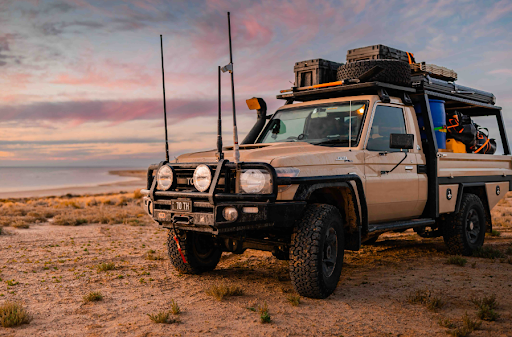
Drivers in the Top End add extra parts for protection, recovery, lighting, storage and communication, and most of these 4×4 accessories Darwin roads and tracks demand are made for tropical heat, wet season floods and routes far from town. Factory vehicles are not made for such conditions. So the extra parts are added to cover what is missing. Bull bars, snorkels, recovery boards and UHF radios, every one of them is solving a different problem of the Top End.
Two seasons are there in Darwin, the Wet and the Dry. Heavy rain, strong humidity and flooded creeks come in the Wet. In the Dry, dust and corrugated roads are the main trouble, and between one fuel stop and the next there is a long distance. Stress on the vehicle comes in both seasons, only the kind of stress is not the same.
Rust also comes faster because of the salt in the air near the coast and the humidity all year. This is why powder coated steel, aluminium and stainless parts are often chosen for accessories here, as corrosion is resisted better by these materials.
What Protects a Vehicle From Wildlife on Territory Roads?
Wallabies, buffalo, cattle and wild pigs are often seen walking onto the highway, mostly in the early morning and at dusk. Radiator, lights and bonnet can be damaged if the vehicle hits one of them.
Parts commonly used for protection are:
- Bull bars, which cover the front of the vehicle
- Steel bash plates, made for the sump and transfer case
- Rock sliders, which guard side panels and sills
- Headlight protectors, to stop damage from flying stones
A winch mounting point is available on some bull bars too. Later, the same bar can be used as an anchor point when recovery is needed.
How Do Snorkels Help During Wet Season Crossings?
The air intake of the engine is lifted up to roof height by a snorkel. Water does not enter the engine easily in this way when a creek is crossed. Cleaner air from a higher place is also taken in on dusty tracks. Very serious damage is caused when an engine swallows water, so in flood areas a raised intake is a practical upgrade.
Still, the whole vehicle does not become waterproof with a snorkel. Differentials, gearbox and electrical parts also need proper breathers and sealing, if deep water is going to be crossed.
Why Is Recovery Gear So Common in the Territory?
A vehicle can get stuck in mud, soft sand or a washed out track, and sometimes help is very far away. Getting the vehicle out in a safe manner is possible with recovery equipment.
Typical recovery items are:
- Recovery boards, for grip in mud and sand
- Snatch straps and rated shackles
- Winches, mounted at the front or the rear
- Air compressors and tyre deflators
- Hydraulic or high lift jacks
When tyre pressure is made lower, the weight of the vehicle is spread over a bigger area. For this reason, it works well on sand and loose ground.
What Do Lighting and Communication Gear Do Out Bush?
Almost no street lights are found on the rural highways of the Northern Territory. Auxiliary driving lights and light bars give the driver a longer view at night, so animals and objects on the road can be noticed with more time.
Mobile signal also goes away soon after the town is left behind. Other vehicles and trucks nearby can be talked to with a UHF radio. Where there is no signal at all, satellite communicators and emergency beacons are used as the backup.
How Does Storage and Camping Equipment Support Long Trips?
Kakadu and Litchfield national parks are popular places, and for many trips there, one night is not enough. The load is kept in order and fixed in its place by roof racks and cargo barriers, and food and tools are protected from dust by drawer systems.
Other additions often seen are:
- Awnings, for shade in the hot afternoon
- Extra water tanks, for stays in remote places
- Dual battery systems, for fridges and lights
- Rooftop tents, which keep the sleeping area away from wet ground and snakes
Shade and cold storage are very important here, because for most of the year the daytime temperature remains high.
Why Do Suspension and Tyres Matter in Remote Areas?
On corrugated dirt roads, the vehicle is shaken all the time. The extra weight of the gear is carried by upgraded suspension, and better control is given on rough surfaces. Punctures from sharp rocks and sticks are less likely with all terrain tyres that have stronger sidewalls.
A full size spare tyre and a puncture repair kit are normal to carry on remote routes, since the nearest workshop can be hundreds of kilometres away.
What Is the Main Takeaway?
Hard on vehicles is the Top End environment. Which parts are useful is decided by heat, floods, wildlife and long distances. Protection for the vehicle, safer travel and fewer problems on remote trips come when the right 4×4 accessories Darwin conditions demand are chosen.